
June 1, 2025
Solemnity
of the Ascension of the Lord
Year C
Christ ascends to heaven between light and Spirit, welcomed by the Father; the Church invokes him from below, following in his footsteps towards salvation.
FROM UNDER HIS FEET
Detach in order to attach.
T. de Chardin
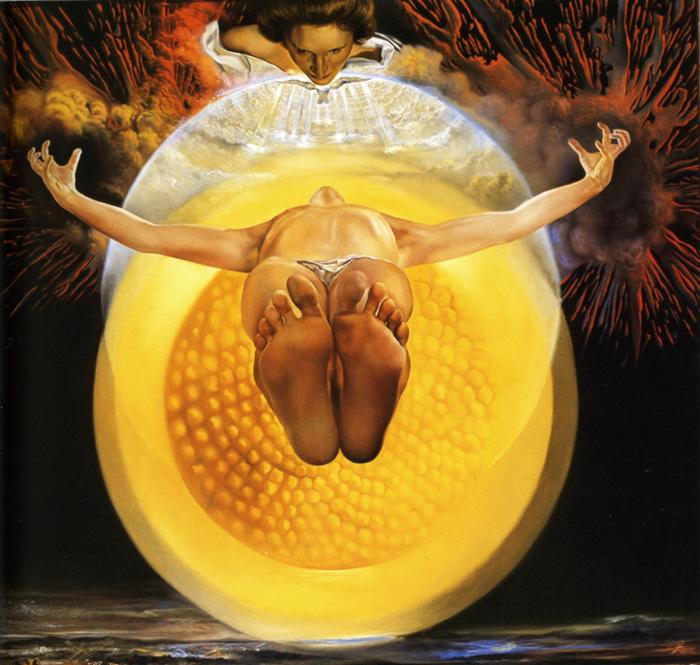
The great inspiring goddess of Salvador Dalì (1904-1989) was Elena Dmitrievna D’jakonova better known as Gala (pseudonym given to her by her first husband Paul Éluard). Dalì claimed that she was the woman who had saved him from madness and premature death. In fact, behind the genius there was a very fragile, disorganized and insecure man who nevertheless opened his days by saying: «Every morning, when I wake up, I feel a supreme pleasure, the pleasure of being Salvador Dalì». It was Gala, intelligent and shrewd, who acted as a link between the Catalan painter and the real world. But before Gala, Dalí met the poet Federico García Lorca with whom he also had a stormy love affair before fleeing to Paris, thirsty for money and glory. However, Lorca was among the first to understand the surrealist language of our artist. Surrealism, as is known, established itself as an avant-garde artistic movement after the First World War and opposed the dominion of reason by affirming the value of the unconscious in the process of artistic creation and giving life to dreamlike and irrational works. In 1958, Dalí painted an extraordinary and highly original Ascension of Christ. To understand it, we must first compare it with another, more famous work, The Crucifix of Saint John of the Cross (1951). In the Ascension, the perspective starts from the bottom and rises upwards to the point that the body can be seen from the feet (influence of Mantegna). Most likely, Dalì describes the moment in which Jesus ascends to heaven under the astonished gaze of the disciples. In the Crucifixion, however, the view is from above and points downwards. Here Jesus is under the gaze of the Father. However, Jesus’ face is never seen; it is directed towards the Father (Ascension), and towards us (Crucifixion). Two contrasting views, therefore. From the Father to the world, from the world to the Father. The bridge between these polarities is Christ the Lord. But be careful, it is important to look at Christ from under your feet – says Dalì – because from that position we can see Heaven, that Heaven of which he is the living way (cf. Heb 10:19-20). Jesus, ascending to God, maintains the posture of the cross (his hands are still tense in the spasm of pain). Jesus then passes through two luminous globes, one yellow (a sunflower? an atom?) and one white. At the top a female face, that of Gala and, a moment before, the dove of the Spirit. What is the reading of this complex symbolism? For Dalì, the luminous globe represents the Father who welcomes the Son in his glorious return. Gala, then, is not only the beloved wife but also a figure of the Church, which together with the Spirit cries out: “Come, Lord Jesus” (cf. Rev 22:20). If it is true that the Head has reached glory, the Body is still in exile. Not only does it invoke: Maranatha, but it is also, as we have said, under the feet of its beloved Lord. Why? Simply because this is the posture to reach Heaven, as we have said. But it is not enough. It is also necessary to follow in the footsteps of the Master (cf. 1Pt 2:21), bearing witness to the Gospel with one’s life, as Isaiah had already prophesied: “How beautiful are the feet of the messenger who announces peace, of the herald of good news who announces salvation, who says to Zion: Your God reigns” (cf. Is 52:7).
Commentary by b. Sandro Carotta, osb
Abbazia di Praglia (Italy)
Translation by f. Mark Hargreaves,
Prinknash Abbey