

October 18, 2026
29th Sunday
in Ordinary Time
To Caesar goes the tribute; to God, our whole life: the disciple remains free from every idol and belongs only to the Lord.
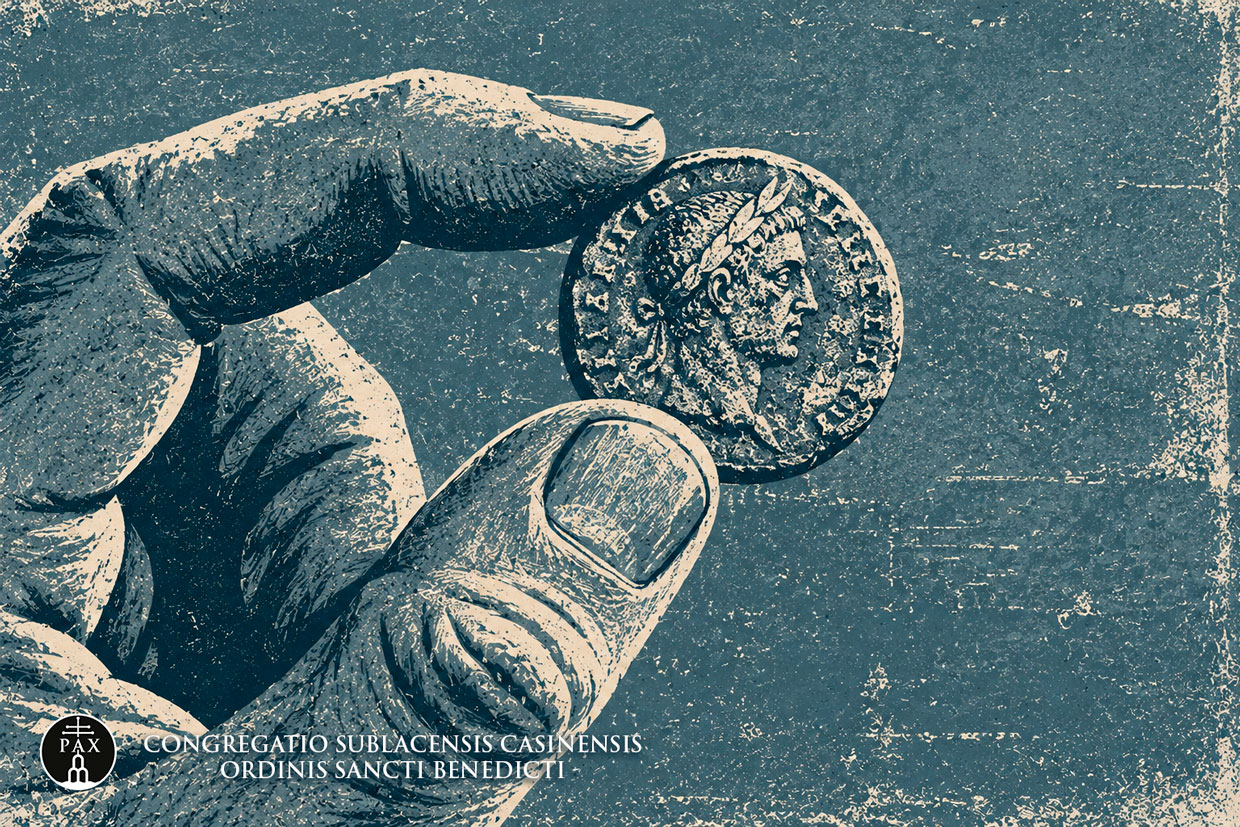
RENDER UNTO CAESAR HIS DUE
We read in Mt 22:21: “Render therefore to Caesar what is Caesar’s, and to God what is God’s.” How are we to understand this historic statement by Jesus? First and foremost , we must remember that Caesar represents worldly power, with its laws and dynamics, while God is the Creator of heaven and earth. Giving to Caesar what belongs to Caesar, then, means obeying the established authority when it demands a tribute or a tax (which is the context of our passage). The Caesaris tributum is not the Diaboli tributum. What Satan demands—as we see in the temptations of Jesus—is a tribute that contradicts the Lord, faith in Him, and filial love for Him. No, Caesar does not ask for this. Caesar asks only for the nummus—that is, the coin, the tribute. For this reason, the tribute must be paid. But what could Caesar never ask for (and therefore what must we never give to Caesar)? That which belongs to God. And what does man have from God? Himself. More specifically: his own body, his own soul, his own will. Ergo: when I hand over—whether forced or willingly, for my own interests—even a part of myself to Caesar, I am in reality committing an injustice against God, while at the same time wounding my own truth. Jesus, then, draws our attention to a detail: who is depicted on the coin? Caesar. It follows, then, that rather than giving it to him, we must return it to him. It belongs to him. And if Caesar likes to have himself depicted on a coin, where, on the other hand, is God depicted? On a coin? Certainly not, but in man, created in his image. That is why man, who belongs to God, must be returned only to God. To Caesar, the tribute in this world—and let us add, for our livelihood. But nothing else. To God, however, man in his entirety. If it is true that the coin must be returned to Caesar because it is his, then paying tribute is a duty. Is that all? For Jesus, it is both a duty and a liberation. Yes, giving to Caesar what is his means freeing oneself from everything in man that is not the image of God. It is no coincidence that Fathers such as Origen and Ambrose interpret the Gospel’s call in the light of “leaving everything” to follow Jesus. And there are many things within us that are not the imago Dei ; think of idols. In a word: the tax orthe aurum weighs us down, so we must rid ourselves of it to follow Jesus. We can also put it this way: what does not matter to us and must not matter, we must give to Caesar and thus follow Jesus freely—whom Giuseppe Ungaretti called “the sublime free one.” One final point: the fact that Jesus pays the tribute means that he is free from Caesar’s logic (as we have already noted); this does not mean that he opposes Caesar’s authority—on the contrary, he even acknowledges it, precisely because it in no way concerns the authority to which he obeys, that of the Father and his Kingdom.
Commentary by d. Sandro Carotta, osb
Abbazia di Praglia (Italia)