
October 11, 2026
28th Sunday
in Ordinary time
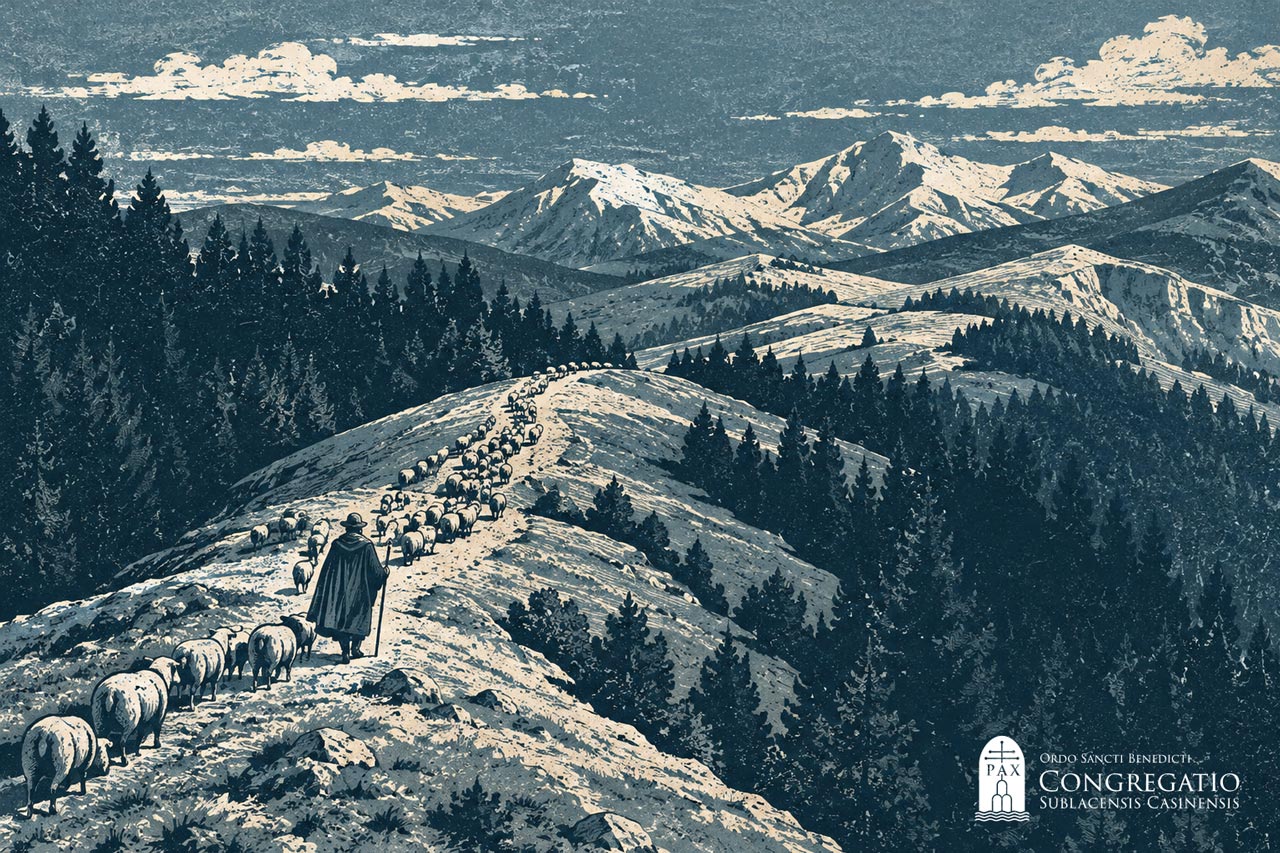
The Lord is the Shepherd who guides, nourishes, and seeks out every person with faithful love: even in the dark valley, he gives hope and life.
TZALMANET
This Sunday, we want to focus our attention on Psalm 23, one of the most beloved psalms in both Jewish and Christian traditions. It is attributed to King David, as the heading indicates (cf. Ps 23:1); it is amizmor—that is, a melody set to words. The psalm is therefore not a meditation but, precisely, a song, and to understand it, it must be sung. David, as we have said, is its author. And the fact that it is David himself who sings of God as a shepherd is significant because, as 1 Sam 16:11 reminds us, he had once been a young shepherd. David begins by saying, “The Lord (YHWH) is my shepherd” (23:1b). That the title attributed to God is YHWH is important because it helps us understand that the God being celebrated is the God of the covenant. Let’s look at the structure: verses 1–3 speak of God in the third person—a God like him; verses 4–5 speak of God in the second person—a God like you; verse 6 is a concluding reflection. Note this: when his experience of faith is joyful, David speaks ofGod; when the experience is—or may be—painful, he speaks toGod. In the first verses, he recounts what God does—God’s care—and then his personal entrusting of himself to God. David entrusts himself after having experienced God’s faithfulness. What does the shepherd do? Let’s return to the opening: YHWH roi lo eisar. Roiis the active participle of the verb ra’ah, which means to shepherd, guide, and nourish. The active participle describes a present and ongoing action. God, then, is the one who continually shepherds me, says David. Not only that, but He continually leads me to green pastures and still waters. And this refreshes me on my journey. Therefore, even if I were to walk through the valley of the shadow of death (tzalmanet), I would fear no evil. Here we have an important term: tzalmanet , to which we can assign two meanings—“shadow of death” and “deep darkness”.. Tzalmanet is composed of two parts: tzal, meaning “shadow,” and mavet, meaning “death.” This shadow of death is a very dense, deep, and dark darkness, and it refers to two things: the valleys that the flocks had to pass through to reach new pastures—valleys fraught with danger from bandits or wild beasts. The inner valleys of the one praying. Tzalmanet also appears in Job 10:21–22 and describes a place without order or a darkness that annihilates (cf. Job 3). In Psalm 44:20, however, it refers to a form of oppression. Yet there, YHWH is present: Kiy atà imadi (for you are with me). And this presence is at once a defense (staff) and a guide (lead rope). This shepherd from v. 5 then becomes a host. One no longer grazes but enters the hospitable tent where the host prepares a bountiful feast. It is well known that in the East, when one entered someone’s tent, one automatically became a guest, and the guest was sacred. Hence the finest food, but also the oil to anoint the head and the wine overflowing in the cup. Psalm 104:15 reminds us that God provides: “Wine that gladdens the heart of man, / oil that makes his face shine, / and bread that sustains his strength.” The conclusion is also extraordinary: “Goodness and steadfast love shall follow me…” (v. 6). For “goodness” we have the term tob and for “faithfulness” hesed. Well, God’s faithful love will accompany me, says David. Here we have the verb yirdefuni, which is translated as “will pursue me.” We can therefore translate it more accurately as: “Goodness and faithfulness will pursue me…” to express the faithful love with which God actively seeks out every person. And this is not for just one day but for every day until we enter into full communion of life: “And I will dwell in the house of the Lord (the temple) for many, many years.” The dark valley—or, as Hosea writes, the valley of Achor—has thus been transformed into a gateway of hope (cf. Hos 2:17).
Commentary by d. Sandro Carotta, osb
Abbazia di Praglia (Italia)