

10th May 2026
Sixth Sunday
of Easter
The Pasch is an interior journey: from the cross and from the depths to the light. Sorrow does not vanish, but becomes an opening through which a new life is born.
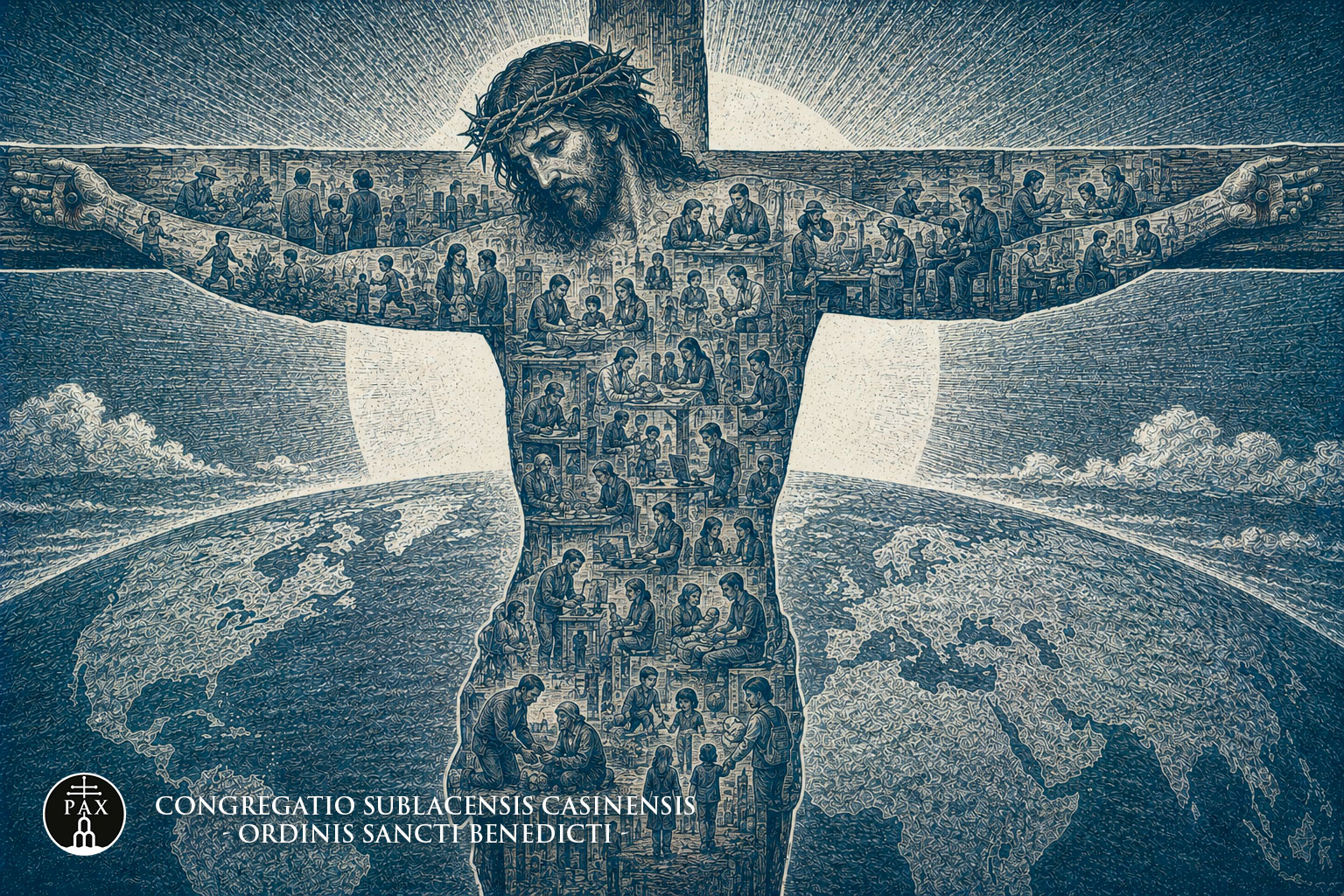
BEING BORN TO THE LIGHT
Conca lucente
trasporti alla foce del sole?
Torni ricolma di riflessi,
anima,
e ritrovi ridente
l’oscuro.
G. Ungaretti
Grief needs to be felt.
J. Green
The Christian Pasch is not only a dogma of faith, but also an interior experience, insofar as it is a sign of the passage from darkness and the birth into light. The great psychotherapist C.G. Jung grasped that in the death and resurrection of Christ is one of humanity’s most powerful and fruitful archetypes. The Pasch – passion, death and resurrection – is not just an historic and theological fact, but also, as we have already recalled above, a sort of drama of the soul, a path which each must follow in the process of their individualisation. The faith affirms that Jesus died on the cross, then descended into the depths and rose again on the third day. This departure and return is also a symbol of man’s journey.
What does the cross represent? The tension of opposites, the suffering I experience in the conflict between passions, duties and ideals. It is the place where the work, necessary for the full development of each individual’s being takes place. The depths are the night of the soul, the loss of certainties, the falling-apart of the person. They are the realm of the shadow precisely on account of so many repressed aspects which await integration. Hell is the counterpart of our identity. The resurrection, finally, is the coming of a new wholeness of the I, of its being reunited and transfigured. The possibility of a new life. Certainly the wound suffered does not disappear but it nevertheless becomes the narrow opening through which the light shines. Suffering is thus a place of revelation.
In this way Christ Jesus is not just a master of morality, but also an interior principle accompanying the truth of every man – he makes him understand that every departure is also an arrival, thus that in order to be joined to him it is necessary to rise from the dead.
Jung, with great mastery, was then able to join the resurrection with hope, hope which is not a superficial optimism but the ability to cross abysses. Ungaretti, once more, in his “Sereno”: “After so much / fog/ one/ by one/ the stars reveal themselves. / I breathe/ the coolness/ which leaves me/ the colour/ of the sky. I recognise/ the images/ are transient. / Held in a circle/ immortal”.
Commentary by d. Sandro Carotta, osb
Abbazia di Praglia (Italia)
Translation by b. Giles Conacher
Pluscarden Abbey (Scotland – UK)