
March 1, 2026
Second Sunday of Lent
Year A
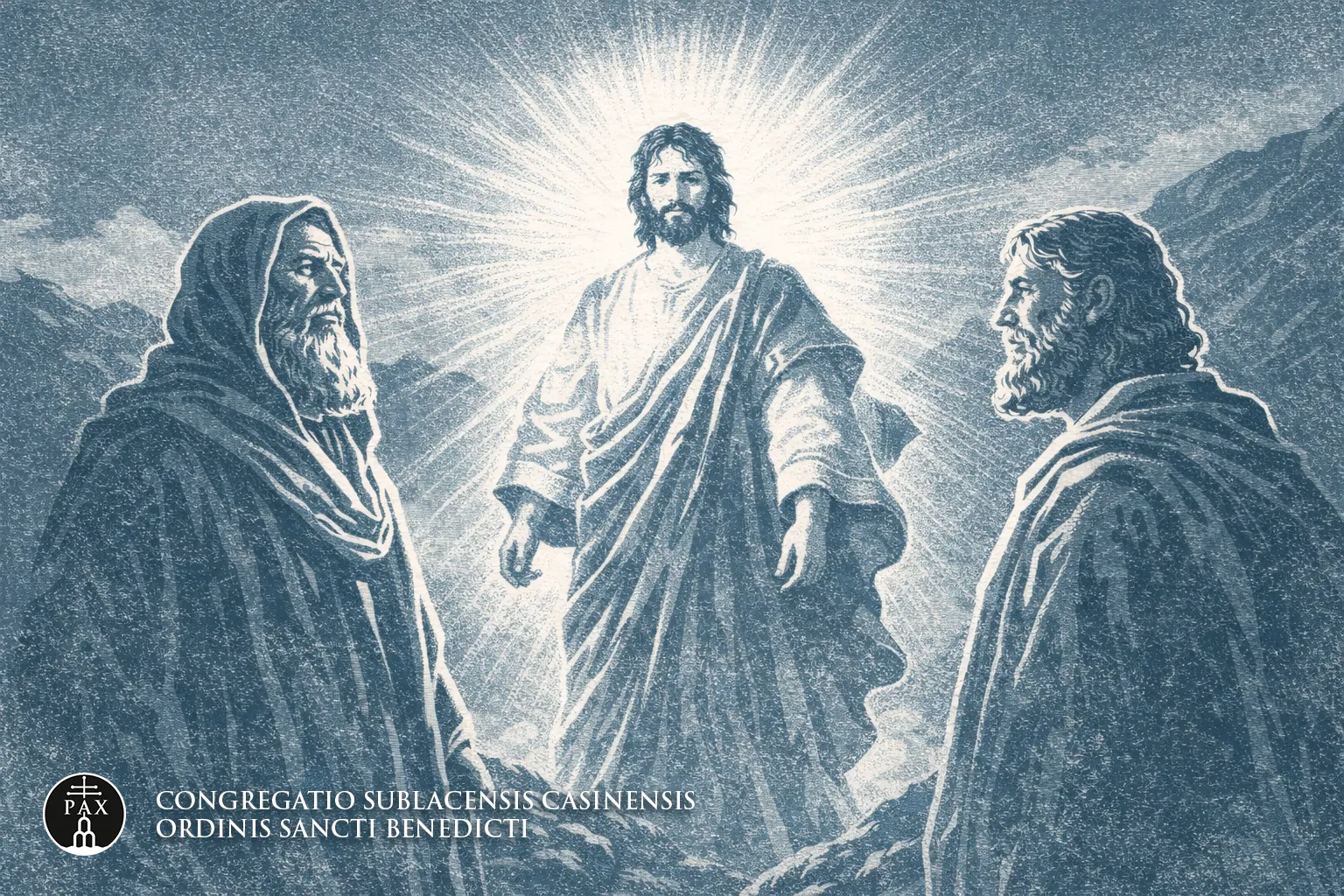
On Tabor, Jesus reveals that God dwells within man as light. Listening to the Son opens the heart to transfiguration and prepares for Easter.
IN THE LIGHT OF COMPLETION
After entering the desert of trial, today we ascend the Mount of Transfiguration. But what does this celebration have to say to us on our journey toward Easter? On Tabor, Jesus was transfigured. What does it mean? That Jesus, by transfiguring himself, gave a body to God, and God inhabited a human body. Indeed, God makes himself visible through Jesus and does so by transfiguring him, by making him luminous, because He, God, is light. This helps us understand something important: that God dwells within us. He is mysteriously within us, and He is there as light, as a radiant presence. When Rilke remembered, in one of his poems, Francis of Assisi, whose eighth centenary of death we commemorate this year, he said that the Saint, in his following of Christ, “always rose from light to brighter light. And he built his cell in that serenity.” Francis’s Christian journey was an ascent into pure light. But how do we access this luminous fire? The Gospel shows us the way: listening. We must listen, says the voice from heaven, we must listen to Jesus, the beloved Son. Only through listening do we reach the light. Let us think, in this regard, of Augustine, in the famous passage from the Confessions: “Spurred to return to myself, under your guidance, I entered the intimacy of my heart… (Augustine enters into himself, he listens to his heart, and this listening opens him to vision). I entered and saw with the eye of my soul… an unalterable light above my own interior gaze… It was not the earthly and visible light… It was another light, very different from all the lights of the created world… It was the light that created me.” It was God. And then, to return to Rilke’s metaphor, from “that serenity” everything is transfigured and the shadows dissolve; or rather, the shadows become the prelude to the light, as silence to the word, night to dawn, tears to joy, death to life.
Who will write to you, divine light
that proceeds unchanged and immutable
from my redeemed gaze?
Not I: because the essence of possessing
you is an eternal and elusive “secret”;
not I because by merely naming you
I deny you and lose you
you, strange truth that reminds me
of the longed-for tone of my being.
Alda Merini
Commentary by b. Sandro Carotta, osb
Abbazia di Praglia (Italy)
Translation by f. Mark Hargreaves,
Prinknash Abbey