
February 15, 2026
VI Sunday
in Ordinary Time
Year A
Jesus fulfils the law by bringing it to its source: love. Relationships become a place of faith, lived in truth, reconciliation, and mercy toward all.
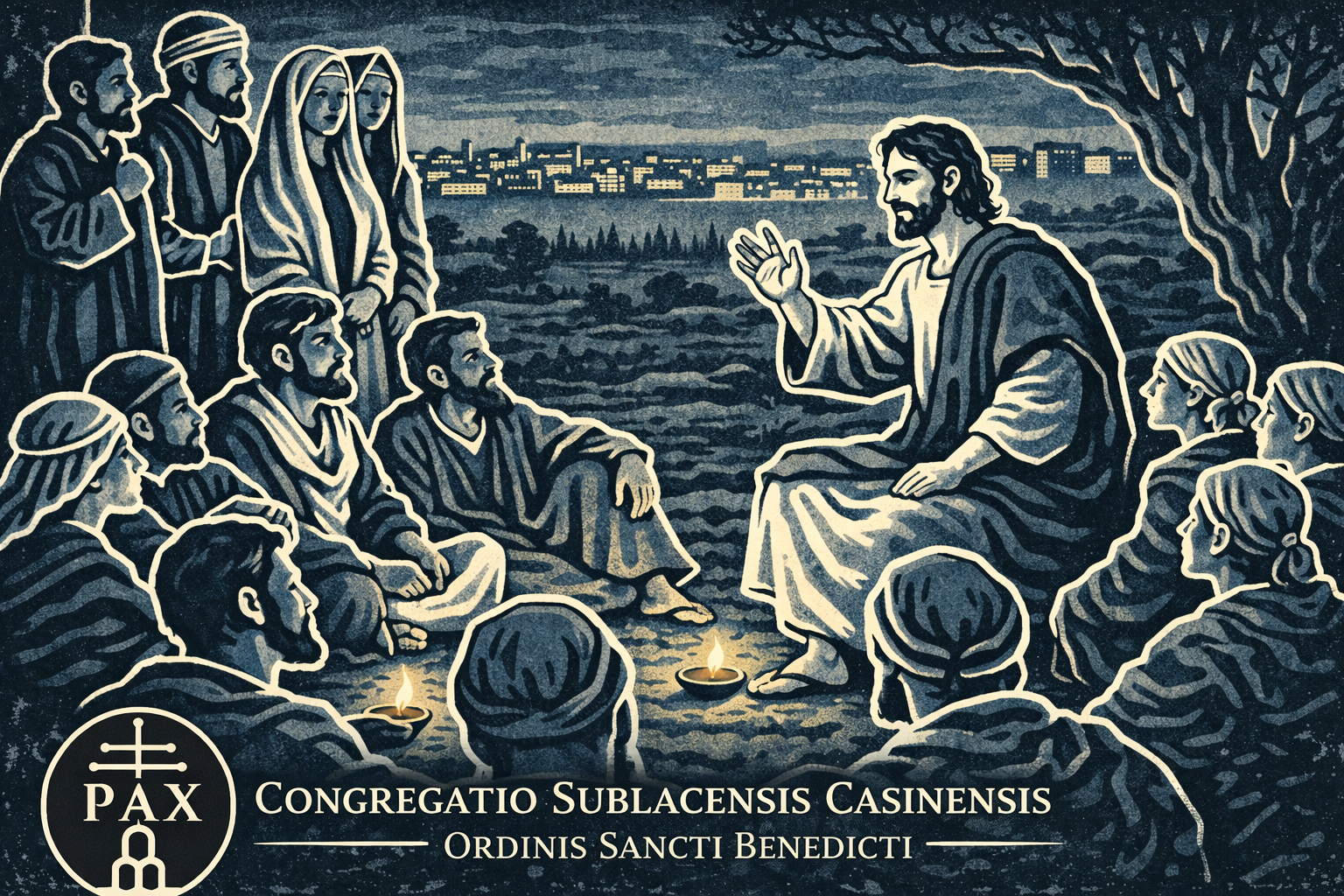
The first discourse found in the Gospel of Matthew is usually called the Sermon on the Mount. In its first part (cf. Mt 5:21-48), as is well known, Jesus rereads the Decalogue (though not in its entirety). According to his words, he comes to fulfil the law (cf. Mt 5:17-19), then he gives a rereading, albeit selective, of the ten words. We are faced with a new promulgation that reveals the true nature of God’s law. If we look carefully, Jesus makes a choice within the Decalogue, that is, he retains those words that concern:
- blood (“You shall not kill”: 5:21);
- sex (“You shall not commit adultery”: 5:27);
- speech (“You shall not perjure yourself”: 5:33).
Then he adds three more, not taken directly from the Decalogue but from the law:
- divorce (5:31);
- the law of retaliation (5:38);
- love of neighbour (v. 43).
Furthermore, he omits very important words from the Decalogue, such as those concerning guarding one’s parents and observance of the Sabbath. The fact that Jesus made a precise selection conveys a message: that of insistence on interpersonal relationships. In short, faith is played out within human relationships. We then find a very original peculiarity. Faced with an “It has been said,” Jesus makes his own: “But I say to you” heard. The two expressions are not antithetical. “It has been said” does not refer directly to the word of God but to the oral tradition of the scribes. In fact, one did not read the biblical text but rather listened to its interpretation according to the
various exegetical schools. The “But I say to you” is therefore not antithetical to the “it was said” of the ancients. Jesus does not annul the given law but affirms that it can mean much more than had been understood until then. Jesus therefore opens the way to a deeper revelation by taking his interlocutor to the origin of the law, to its very divine source. In this way, the law is surpassed because the source of the law is more than the law. Jesus, naturally, is on the side of the source (of God).
You shall not kill (Mt 5:21-26). For Jesus, the beginning of murder is anger: “Whoever becomes angry” (Mt 5:22). But why is anger serious? Because it kills love. Not only that, when anger is not quelled, it turns into insult: “Whoever calls his brother, ‘You fool!’… ‘You fool!'” (Mt 5:22). The matter is so serious that it deserves to be judged by the Sanhedrin. Then Jesus transports him to the highest point of the temple where the sacrifice is offered. But memory brings back and brings to mind the brother’s resentment. For the disciple of the Gospel, his brother’s suffering is more important than the offering to God. What to do? Simple, the reverse path: from the altar to the resentful brother. Sacrifice is pleasing to God when one is reconciled with one’s neighbour.
You shall not commit adultery (Mt 5:27-32). Rather than commit adultery, it is better to pluck out one’s eye and, with it, one’s hand. What does Jesus mean by this atrocious image? Clearly, it should not be taken literally (Jesus presupposes the intelligence of his interlocutor). What the Master means is to trace, through the eye, for example, the greed that lives in the heart and conditions all man’s actions (hand). It is greed that must be forcefully eradicated. In our verses, by way of completion, we also speak of the precept of divorce, which is not a commandment of the Decalogue and which we find in Deut. 24:1. For Jesus, there is only one case in which divorce is permitted: that of sexual immorality.
You shall not perjure yourself (Mt 5:33-37). Why should we not perjure ourselves? To preserve the truth of the word. But not only that. The risk is that of swearing in the name of God and swearing falsely. The law, therefore, seeks to safeguard the holiness of God. Jesus has the same concern and, more radically, invites us not to swear at all. In short, the words of the Gospel disciple must be so true that they do not require an oath. Let yes be yes and no be no.
An eye for an eye (Mt 5:38-42). If the law of retaliation was a sort of margin to prevent violence, Jesus invites us to go against this law, that is, not to enforce it. How? There are four directions: not opposing the wicked,
giving the wicked more than they want, giving the one who asks more than they want, and finally, not running away from the one who asks for a loan. This is possible only in love. For example, turning the other cheek in a context other than that of healing the one who offends would most likely be a more serious act than revenge itself. Only love justifies such an act. If it were not so, even turning one’s cheek would be nothing more than reflecting back to the enemy one’s hatred, which, having met only the surface. In the wake of passivity, one returns to the interiority from which it came.
You will love…you will hate (Mt 5:43-48). Jesus’ invitation to one’s enemies is surprising. It’s not enough to respond to hatred with love. No, we must take the first step, to be the first to love. For Jesus, neighbour also includes those who behave like enemies. Only in this way can we imitate the Father and become his children. The final statement is interesting: “Be perfect, therefore, as your heavenly Father is perfect” (Mt 5:48). What does the Father’s perfection consist of? We should not interpret Jesus’ expression as an invitation to the impossible (who could ever be as perfect as God?). The Father’s perfection is found in his love for all. Indeed, he sends rain on the just and the wicked. His gift is for everyone, regardless of merit. Behold, Jesus says, the Father is to be imitated in this, namely, in a love that is not measured by merit but that springs from the heart, freely and gratuitously. Such is the Father in heaven, and such must be his children.
Commentary by b. Sandro Carotta, osb
Abbazia di Praglia (Italy)
Translation by f. Mark Hargreaves,
Prinknash Abbey