

February 1, 2026
Fourth Sunday
in Ordinary Time
Year A
The Beatitudes reveal God’s action, point the way to true happiness, and find their fulfilment in Jesus, the man of the Beatitudes. It’s up to us to welcome them and live them.
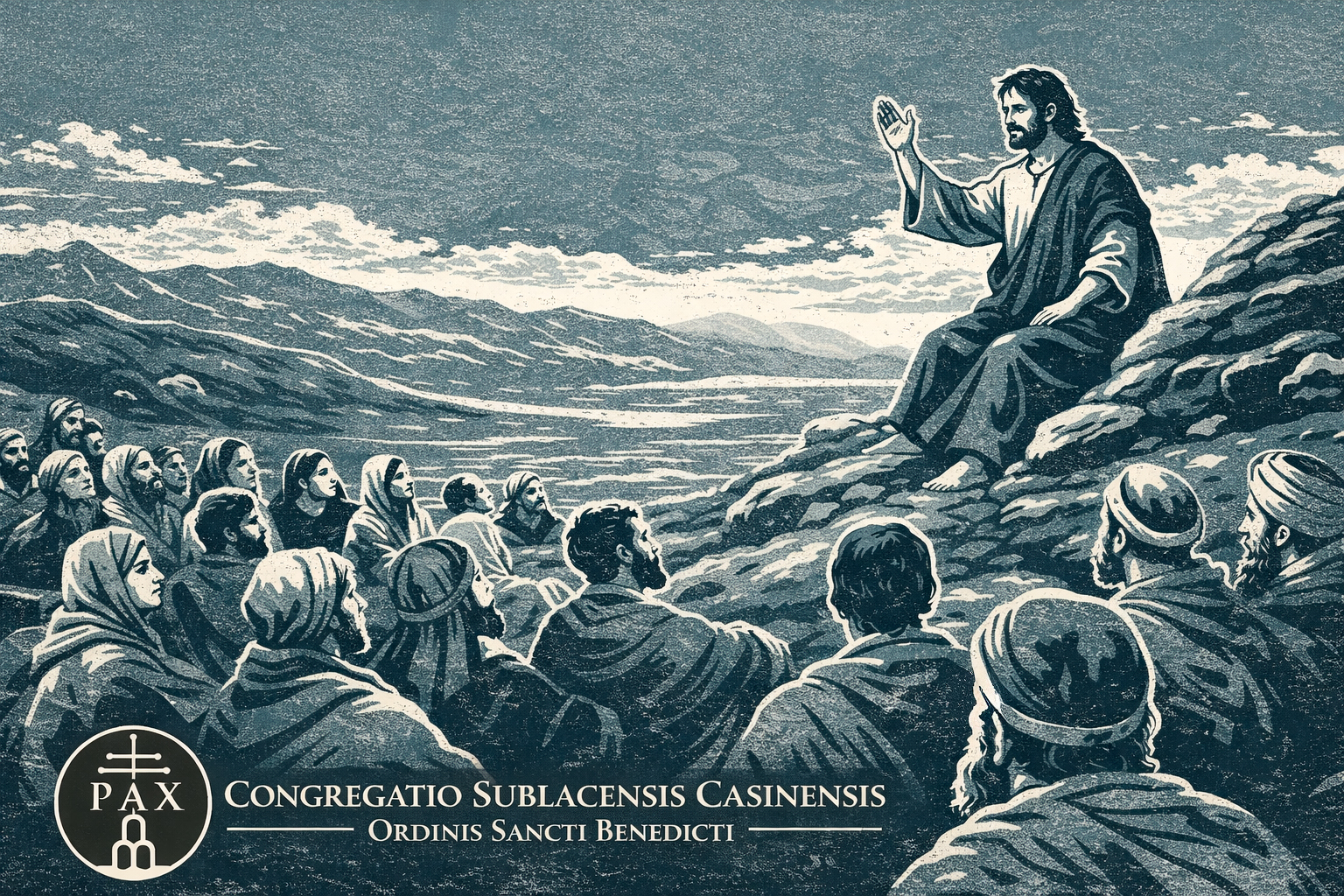
THE WAY TO HAPPINESS
Today we are faced with a well-known, famous, and challenging passage: the Beatitudes. Each of them begins with a declaration of happiness: “blessed”; then it specifies to whom this beatitude is addressed, for example: “blessed are the poor in spirit”; in the third part, the cause of the beatitude is indicated: “for theirs is the kingdom of heaven.” If we look carefully, we realize that each beatitude, in the first part, after the macharisma, speaks of a human attitude or action, while in the second part, it speaks of a divine attitude or action. Divine action causes human happiness. But not only that, divine action makes virtuous human action possible; it is its foundation. Each beatitude then presents happiness as a goal; Human action as the path to this goal; divine action as the motivation and strength to reach it. Let’s dig further. The Beatitudes present to us, as we have said, God’s action toward humanity; an action that varies depending on the various interlocutors. For example, God promises and offers consolation to those who mourn, the promised land to those who are meek. They also present to us human action: here are the poor in spirit, here are the meek, here are the peacemakers. The Peshitta, a Syriac version of the Bible, translates “blessed are you” as “possessors of all blessedness.” The blessed, then, are those who not only have the Beatitudes as a reference but are immersed in them. And The Beatitudes have three characteristics: they are first and foremost a revelation of God. They reveal to us God’s choices, his action in the history of humanity, his love for humanity. They are also a promise, which will be fulfilled in God. To live them—the third characteristic—faith is necessary, that is, belief in Jesus, in his word. Indeed, Jesus is the man of the Beatitudes. But that’s not all; in them, Jesus translated his experience, the fruit of his faith, conceived and practiced. He lived these Beatitudes, and the certainty of these promises sustained him in his daily existence, allowing him to overcome difficulties and hostility. To realize that Jesus is the man of the Beatitudes, we only need to read the Gospel. The Beatitudes, therefore, are not an ideology, a utopia, a simple spiritual doctrine. Jesus spoke them to reveal to us his human experience in which he found beatitude. Certainly, a happiness sometimes at a high price; a happiness that matured in the awareness that a man is blessed only if he loves God and his neighbour. Seneca after the death and resurrection of Jesus wrote: “Everyone wants to live happily, but when it comes to seeing clearly what makes life happy, they are shrouded in darkness.” Well, the Beatitudes are a light that can illuminate our steps toward authentic happiness. It’s up to us to believe and live.
Commentary by b. Sandro Carotta, osb
Abbazia di Praglia (Italy)
Translation by f. Mark Hargreaves,
Prinknash Abbey