

October 4, 2026
27th Sunday
in Ordinary Time
St. Francis of Assisi, Patron Saint of Italy
Francis made his life a Gospel: in silence, brotherhood, and poverty, he revealed Christ with his whole being.
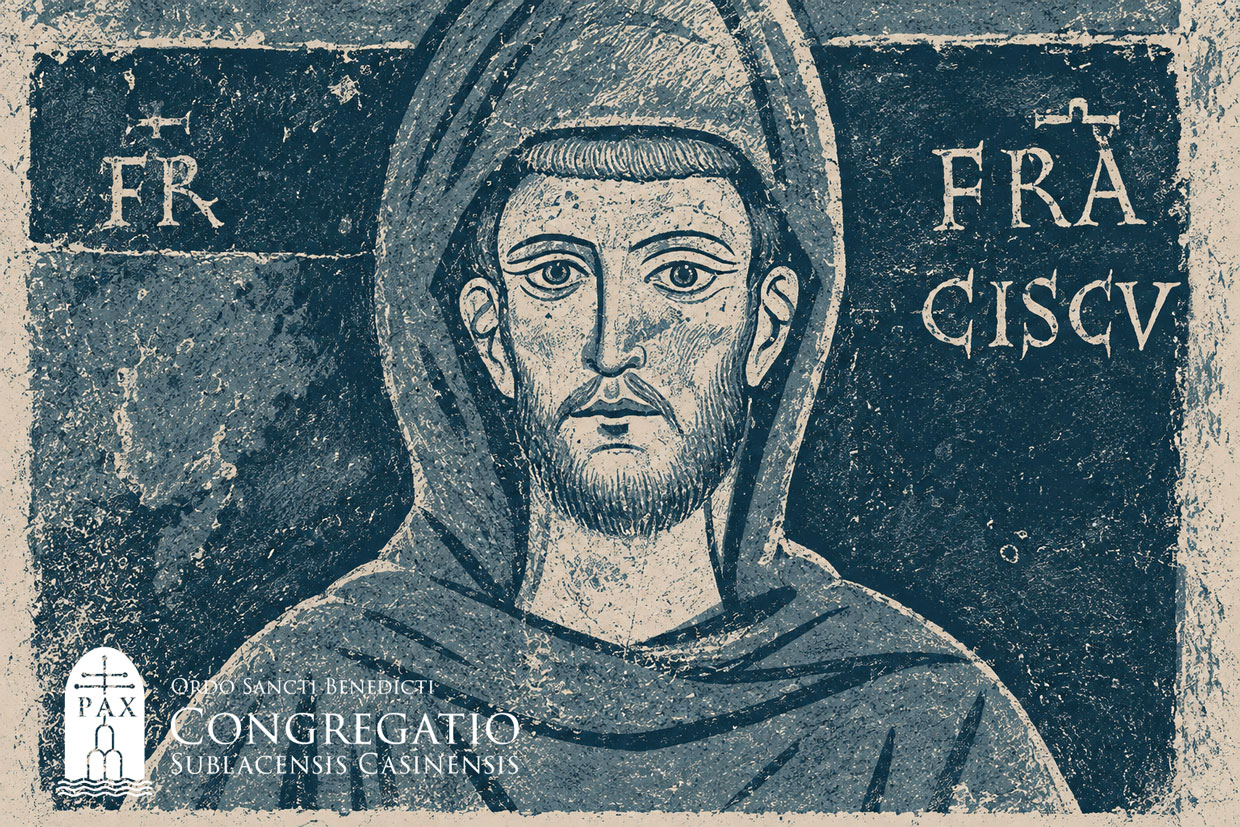
THE SUBLIME FREEDOM
This Sunday marks the feast day of Francis of Assisi, whose 800th anniversary of death was commemorated this year. The Dominican theologian Yves Congar called him “the first after the One.” But who was Francis of Assisi (1182–1226) really? A certain tradition has handed down to us the image of a man who was an environmentalist ahead of his time, a friend of wolves, and so radically evangelical that he was called the “Poor Man of Assisi” or the “Seraphic Saint,” so ardent was his love for God. We know that in 1266, St. Bonaventure, then Minister General of the Order, ordered the destruction of all biographies written about him during the Chapter of Paris. Given his fame by then, what was needed was an image of Francis as a paragon of virtue, obedient to the Roman Church—an angel of peace—but also a figure who could bridge the deep divisions within the nascent Franciscan Order. And so the image we all carry in our imagination was consigned to history. It is important to note, however, that in 2015, thanks to the scholar Jacques Dalarum, another biography—also by Celano—was discovered, now known as the Vita ritrovata (1230–1240). This text reveals an intimate Francis, focused on his humanity, in fraternal harmony with creation and with society’s most marginalized. It all begins with silence, embraced and lived as the primordial space where the word can become true. Silence is the condition for listening, which then matures into the capacity for discernment—that is, the ability to perceive what is often unseen. Thus, Francis hears the lament of the leper, whom he recognizes as a Christian brother; he hears the silent praise of the trampled worm, a figure from biblical memory (cf. Ps 22:6); he hears the whisper of the wind, which speaks of the Creator. But that is not all: here a word takes root that does not wound, a preaching that does not humiliate, and a praise that is not mere rhetoric. Silence is the womb of Franciscan song. Proof? The Canticle of the Creatures, written, as is well known, in 1224 at San Damiano, two years before his death. Light flows from a wounded body; praise springs from pain. He did not write it in Latin or Provençal but in the Umbrian vernacular, the language of his people. In the Canticle, praise rises to God through the creatures. Francis blesses the world and traces it back to the Source from which all things flow. For Francis, creation is a family; there is Sister Water, there is Brother Fire, there is Mother Earth. There is no hierarchy or scale of values. Into this universal brotherhood, too, enter sickness and death. Yes, even death is a Sister because it comes from God and leads to God. Creation is beauty and fragility, limitation and glory. And praise is the response of those who have understood that everything is a gift. Francis was not an environmentalist; he loved creation because in every expression of it, it is a sign of God. Therefore, the Canticle is not a pantheistic hymn to nature; it is not a romantic outpouring of love for created things. To understand this, we must look at Francis as the Speculum Christi, as a faithful follower of the Gospel, as one in love with Christ.
But there is a very significant phrase in the sources regarding how Francis celebrated the Most High God:
De toto corpo fecerat lingua (1Cel 97).
That is:
He made his whole body a tongue.
What does this mean? That Francis, with his whole being, was an eloquent and consistent proclamation of the Gospel. The body is the place where the divine becomes visible. Francis knew that people do not read theological treatises but observe the lives of witnesses. Here, then, is an extremely eloquent gesture: his stripping before the Bishop of Assisi. That naked body, exposed to the gaze of his fellow citizens, was not a declaration of war but a condemnation of every form of possession—of identifying the human being with his possessions, clothes, roles, and social and religious powers. The bishop understood and covered him. The bishop’s gesture was also significant because it was a sort of investiture of the poor. But Franciscan corporeality is not only nakedness but also tenderness. Hence the kiss of the leper, the wounded body of Christ. The leper is Christ—not in a metaphorical sense, but truly, dramatically. From that day on, the body would no longer be an obstacle to holiness for Francis, but holiness itself made visible. Truly, Francis was the sublime free spirit, the blue note of the new song that still resounds among us.
Commentary by d. Sandro Carotta, osb
Abbazia di Praglia (Italia)