
May 31, 2026
Holy Trinity
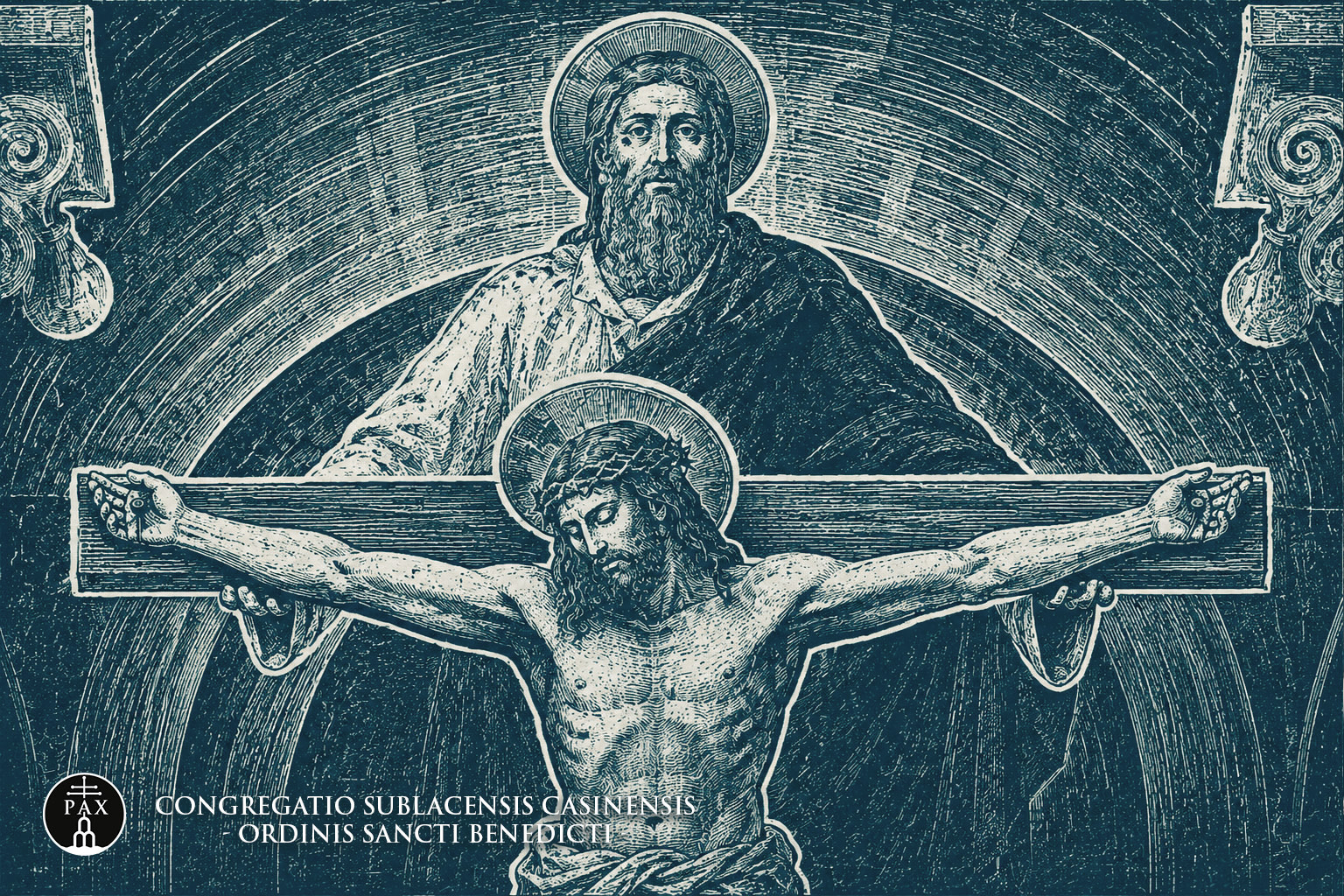
The cross reveals the Trinity. God is love and gives himself. Not in dominion but in communion, where the other does not annihilate our humanity but completes it.
THE UNPUBLISHED REVELATION OF THE INTIMATE LIFE OF GOD, WHO IS “NOT SOLITARY”
My God, Trinity whom I adore –
may I never leave you alone…
you have need of my presence.
Elizabeth of the Trinity
Whoever enters the church of Santa Maria Novella in Florence can see one of the most revolutionary frescoes of the early fifteenth century – Masaccio’s Trinity on the Cross. Undoubtedly, for Masaccio, the Trinity was a dogma, but dogma – and this is what the painter makes it possible to understand – is born of revelation (God gave himself thus) and revelation always occurs in a defined space (hence his use of perspective, which so astounded his contemporaries) and within a specific time. And so God, our God, not only gave himself, but still gives. In sum, the genius of Masaccio managed to translate one of the great Christian truths, precisely the Cross as historic place of the manifestation of the Trinity. This is where our gaze must turn, if it wishes to discover the Trinity. But wait – and this is the second point of our reflection – we are not to associate the cross with sorrow (as we are tempted to do); the cross is understood and makes sense only through love. We should remember that Christ – who incarnates the Trinitarian mind and intention – did not offer to God his sufferings, but what he became in those sufferings. And what did he become? He became a being in whom the total gift of himself plumbed depths of love which alone are capable of saving. That love – which can then resound as good news – seeks not only to reach to the ends of the earth but desires also to dwell in the depths of our hearts. On the cross, therefore, we have the epiphany of the Trinitarian heart.
God the Trinity (third point) therefore appears to us as love. Love and not omnipotence, as we might sometimes think. We can say that his heart is almighty, true, but insofar as it is creating and patient love. And here we understand what love is. Love is the gift of self. A gift which nonetheless presupposes an exodus from self, from our own limits, from our own logic, in order to share in another existence, that of the other. This love gives itself without being destroyed, because the other is not my annihilation (as sometimes we might wrongly see it), but my fulfilment. I believe that individualism, which is so characteristic of our habitual way of living, might have less influence if we were to profess God more as a Trinity of love than as an Omnipotent God. An Omnipotent God has only to dominate and demand obedience. But that God cannot be the living God, but only the caricature of a thirst for power and dominion: and it is certainly not the God of whom Jesus told in his life and in his death. We would finally like to call to mind the fact that in the nineteenth century many theologians saw in the one-ness of the Trinitarian God the original image of a possible human communion between the Church and society. This even led to speaking of a social teaching of the Trinity. It is evident that a Christian community, a believing family, that may be one, unique and unifying wherein relationships are not determined by domination but by gift, by grace, not by law, by esteeming the other and not by self-affirmation to the detriment of the neighbour, reflects the Trinity. We might say that this is the world in which men are characterised not by their titles but by their relationship, whence all is common and all is shared, with the exception of the originality of each. Utopian? That might be our thought today, were we not to celebrate the Eucharist.
Commentary by d. Sandro Carotta, osb
Abbazia di Praglia (Italia)
Translation by b. Giles Conacher
Pluscarden Abbey (Scotland – UK)