
April 5, 2026
Easter Resurrection
The resurrection conquers death without erasing its signs: the Risen One guards the wounds, because only in this way is new life true and credible.
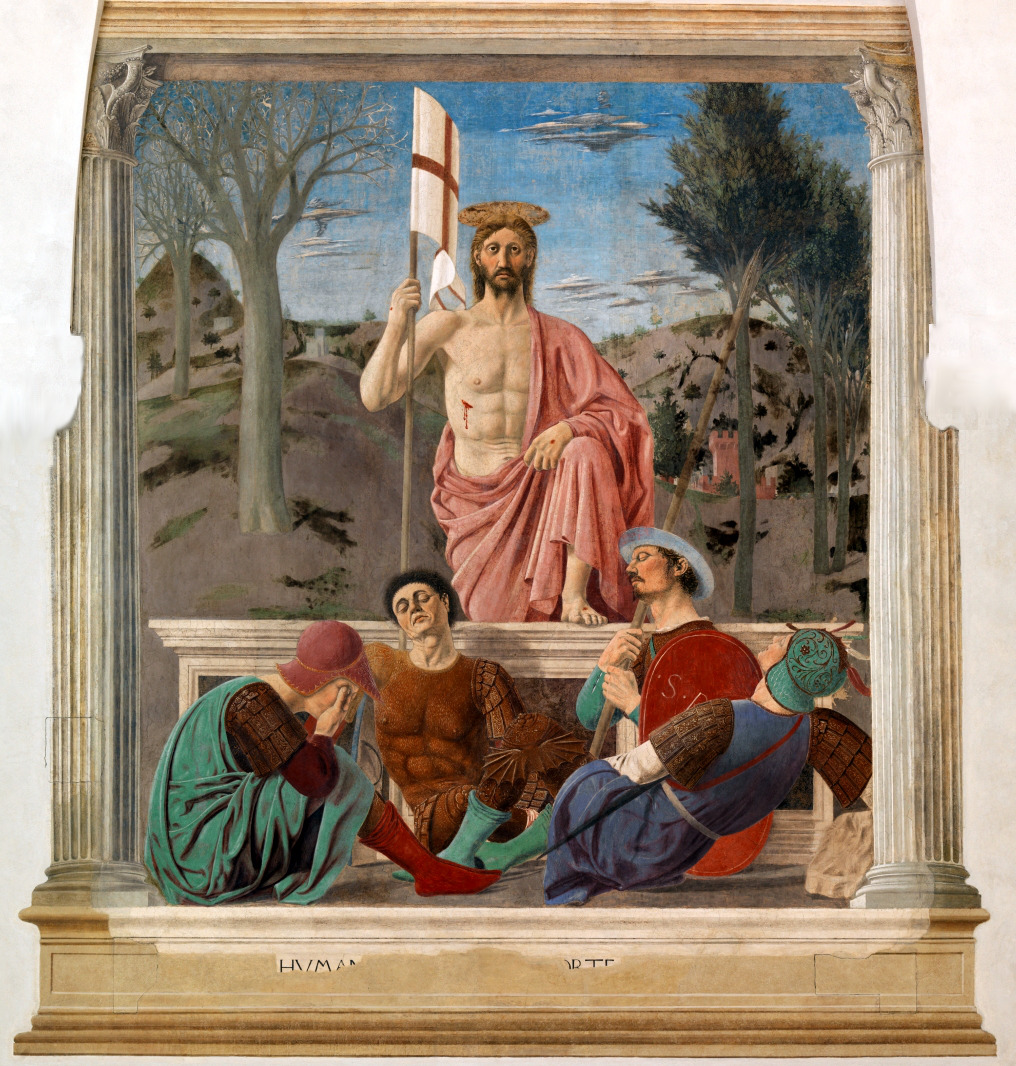
What is death in the light of the Resurrection? A fresco by Piero della Francesca, who left us a resurrected Christ of extraordinary aesthetic and theological power in Borgo San Sepolcro, explains it. The image features an imperative Kyrios gesture: the foot placed on the tomb, indicating the victory over death. That body that had been crucified now stands in the light of another, new time. Indeed, there is a green in the sky fading to blue, and in the center is him, with a rugged, earthy face, just as Piero loved to depict him. There is no longer any sign of the Passion, of pain, of death, nor any movement in that primordial luminosity. As is well known, Pietro’s figures seem to transcend time, fixed in eternity. Thus, the Christ of Borgo San Sepolcro emerges not only from the tomb but from time itself. And yet something still ties him to time, something still ties him to the Passion. There is a small wound on his side, unhealed and still bleeding. Looking at this icon, Bonnefoy asked himself: “Is it true that death, the invention of death, is largely healed here?” There is a fact: the open wound brings time back into the picture, and therefore the Passion and death. The Resurrection of Borgo San Sepolcro thus represents what seemed dissolved into eternity. Death reappears with its very real and tragic signs, with its wounds. And it cannot be otherwise. To be a true resurrection, the Risen One must show in every fiber the truth of his dying and of his own death. Here is the paradox: the body of the Risen One preserves death. Certainly, death is conquered, but its signs cannot be erased. And Thomas wants to see those signs, he wants to touch them. And it is important to see and touch because it means desiring to experience a gift that will never fail: “My Lord and my God,” exclaims the apostle. Thomas not only recognizes the Risen One but expresses a sense of belonging. He does not say, “Lord God,” but, “My Lord and my God.” It could also be paraphrased: “You are my only Lord and my only God.”
A peach branch
in the heart of every man
blossoms today;
in the wounds opened by pain,
the blackcap builds its nest
and sings songs of consolation.
And you, man of the Passion,
in the beautiful month of April, open the furrows:
you have chosen an unusual season
to sow the seed to die!
By these signs of yours I recognize you,
a fascinating stranger on earth,
who knows the bitterness of exile,
and who, under the ignominy,
preserves the splendour of your homeland.
Amen. Alleluia.
Commentary by b. Sandro Carotta, osb
Abbazia di Praglia (Italy)
Translation by f. Mark Hargreaves,
Prinknash Abbey