

March 15, 2026
Fourth Sunday of Lent
Year A
The blind man finds the light by encountering Jesus: humbly recognizing his own humus opens him to the truth, faith, and love that saves.
“DO YOU BELIEVE IN THE SON OF MAN?”
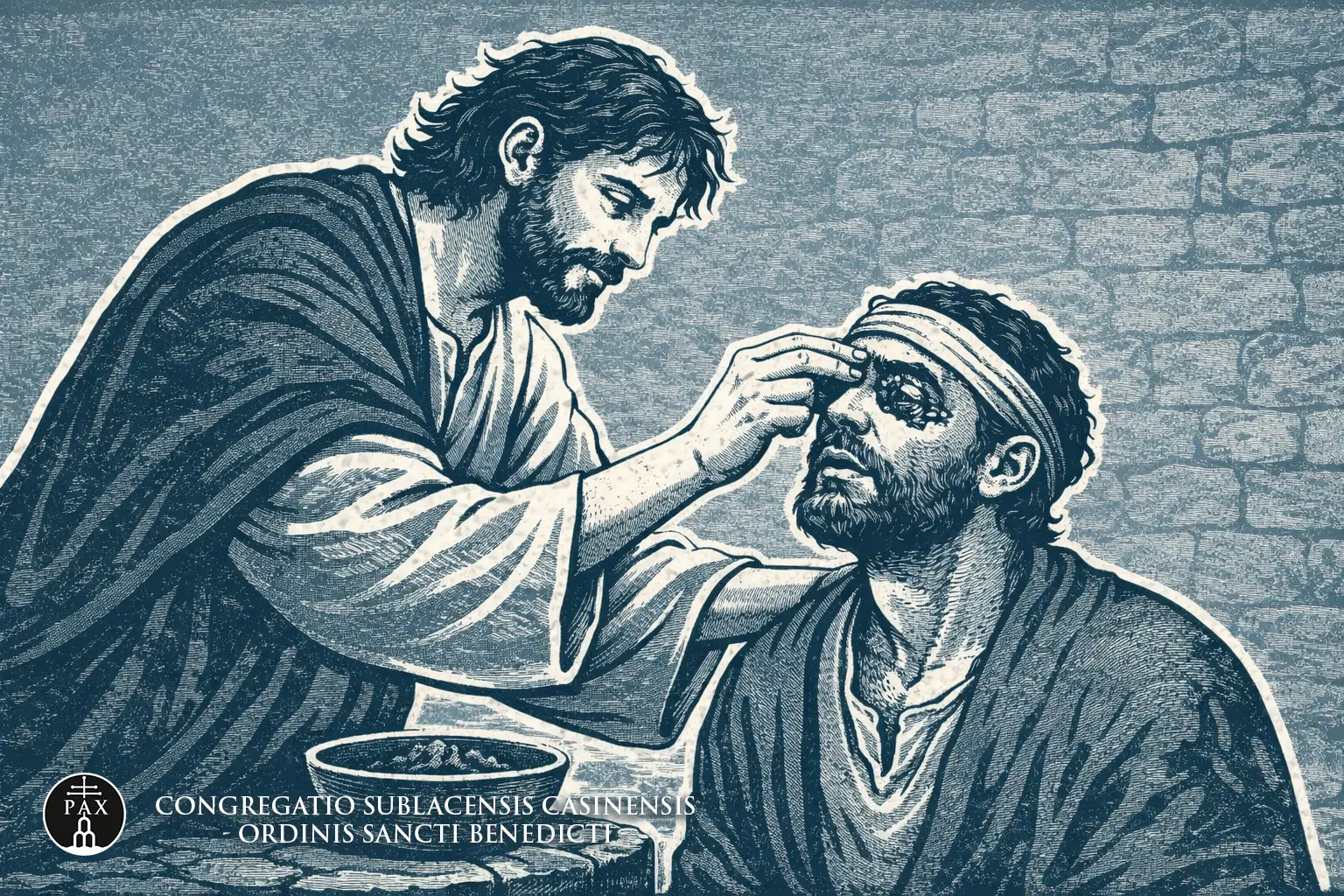
He was born blind, and his blindness also bore the burden of judgment: “Rabbi, who sinned,” the disciples ask Jesus, “this man or his parents, that he was born blind?” (Jn 9:2). In the culture of the time, illness was always a visible sign of guilt. But Jesus breaks this logic by reminding us that neither he nor his parents sinned. For the Master, guilt is secondary; what is decisive is the manifestation of God’s work. So, what does the illness indicate? Where does it lead? Perhaps to rediscovering one’s true self, that is, one’s hidden identity. But by what path? That of faith in Jesus: “Do you believe in the Son of Man?” (Jn 9:35). In short, that blind man, by welcoming Jesus as light, will see his own truth as a man and recognize the world as it is. The Master’s gestures are curious: “Having said this, he spat on the ground and made mud with the saliva. He anointed the blind man’s eyes with the mud and said to him, ‘Go, wash in the Pool of Siloam'” (Jn 9:6-7). This man’s blindness is not merely physical; being blind means refusing to recognize oneself for what one is, unwilling to embrace the shadows that inhabit us. But in doing so, we idealize ourselves, and place ourselves above man himself. This is why the Master spits on the ground, on the humus. Yes, and then passes the kneaded mud over the eyes of his interlocutor as if to say: only if you recognize your own humus will you be able to see. This recognition begins with humility. Humilitas reconciles with humus. Here then shines the light of veritas that restores man to himself. But that’s not all. This man is sent to the Pool of Siloam, which means Sent. We know that Jesus is the Sent of God. Going to the Pool of Siloam therefore means going to Christ, carrying one’s own mud and allowing oneself to be washed by the purifying waters of his faithful love. This blind man is therefore called not only to faith but also to love, to that force that “moves the sun and the other stars” (Paradise XXXIII, 145), and which surprisingly stands before him: “‘And who is Lord, that I may believe in him?’ Jesus said to him, ‘You have seen him; it is he who speaks with you'” (Jn 11:36-37).
On faith in Jesus as love, we make our own some verses by Antonia Pozzi (1912-1938):
I have so much faith in you. It seems to me
that I could wait for your voice
in silence, through centuries
of darkness.
…
I have so much faith in you. I am quiet
like the Arab wrapped
in his white shack,
who listens to God ripen
the barley around his house.
Commentary by b. Sandro Carotta, osb
Abbazia di Praglia (Italy)
Translation by f. Mark Hargreaves,
Prinknash Abbey