

November 8, 2026
32nd Sunday
in Ordinary Time
Prudence means guarding one’s faith while waiting for the Lord, nourishing it with responsibility and perseverance, so that its light may not be extinguished.
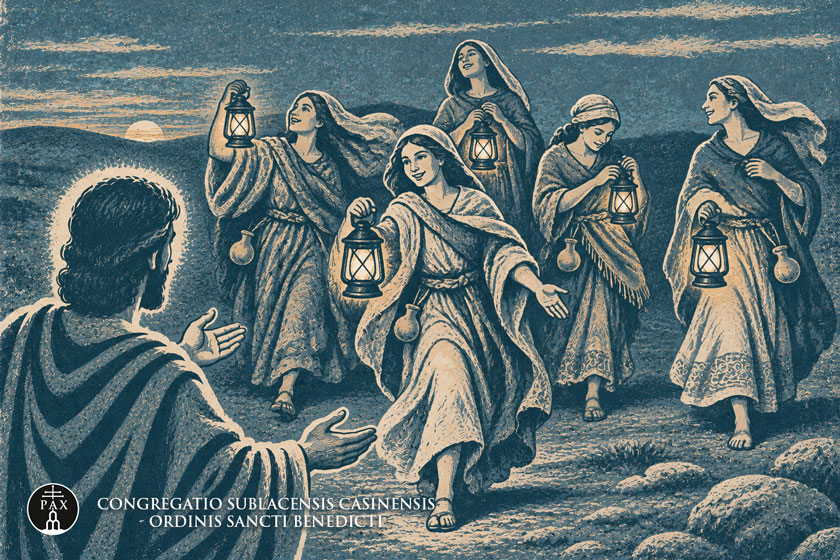
During these last three Sundays before Advent, the Liturgy of the Word focuses on the magnificent narrative of Matthew 25:1–46, where—in a sort of triptych—it illustrates how to await the Lord’s final coming: with prudence (the parable of the ten virgins, Mt 25:1–13), by putting the gifts we have received to good use (the parable of the talents, Mt 25:14–30), and by recognizing the features of Christ in the face of our neighbor (the account of the final judgment, Mt 25:31–46). Today’s focus is on the ten virgins (cf. Mt 25:1–13). The adjective that characterizes the wise ones is fronimoi, which in the New Testament describes sensible people. Let us then reflect, inspired by today’s Gospel, on this cardinal virtue—prudence—which today, more than ever, seems to us to be a rather rare commodity. Plato, in The Republic, asserted that prudence is among the most desirable things in life. An Egyptian sage named Amen-em-ope, on the other hand, noted that the truly prudent person is the one who knows how to stay in their place, and only there do they bear fruit. Prudence is summed up in our passage by a symbol: the reserve of oil carried in small jars. Not all the virgins have the foresight to notice this detail. Setting aside the metaphor, what does it allude to? First of all, the symbol speaks to us of foresight. It is not enough to prepare for the wedding and wait for the bridegroom; one must also anticipate that the bridegroom might be delayed. This implies responsibility and common sense. A second aspect: The oil also points to faith—a faith that, while waiting, can falter and grow cold. Hence the need to safeguard it, nurture it, and allow it to mature along the paths of history. A third and final aspect: expecting that the oil, upon the bridegroom’s arrival, will be shared. This is impossible because each person must answer for their own actions. In Scripture, prudence is a gift from on high (cf. Prov 8:5, 12), which must be asked for (cf. Wis 7:7). It then grows in those who practice it and demands commitment (Prov 14:29). For the Russian poet Olga Sedakova, the lamp of faith is fueled by the oil of sorrow and becomes a testimony to a God ardently awaited:
Burn, invisible flame,
I need nothing else.
They will take everything else away.
…
You, lamp, your oil is tears,
incrinatura del gelo del cuore,
a crack in the heart’s frost,
the smile of one who is leaving.
Commentary by d. Sandro Carotta, osb
Abbazia di Praglia (Italia)