
August 16, 2026
20th Sunday
in Ordinary Time
The Canaanite woman, with humble and tenacious faith, obtains grace: even those who are far away find a place in God’s heart, which is open to all.
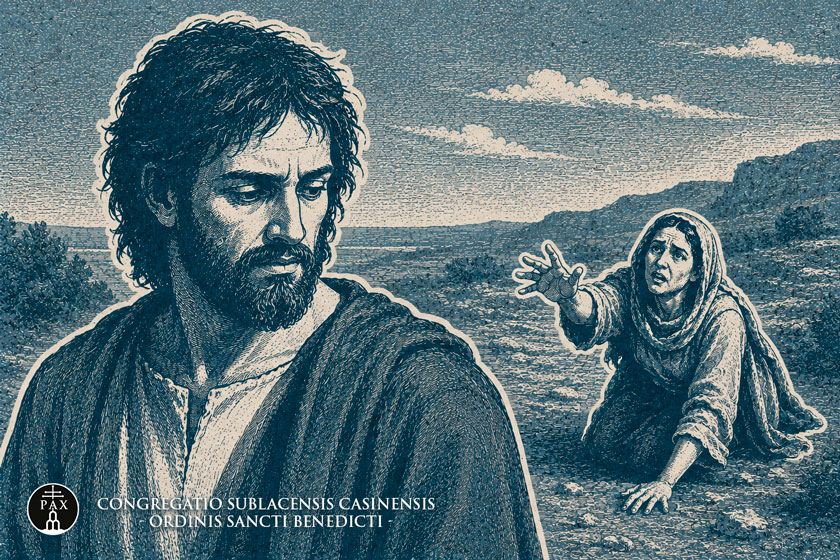
THE WOMAN WHO CONVERTED JESUS
There is a truly remarkable woman in the Gospels, the Canaanite woman (cf. Mt 15:21-28; Mk 7:24-30). She is of Greek and Syro-Phoenician origin, a foreigner to the Jewish people and therefore a pagan. This woman has a sick daughter, tormented by a demon. She is thus a distressed mother, though not a desperate one. This makes her similar to so many mothers around the world. Faced with suffering, she plays her last card: she goes to Jesus, whom she had likely heard about. It doesn’t matter that she belongs to another faith. When she sees him, she cries out: “Have mercy on me, Lord, Son of David! My daughter is severely tormented by a demon” (Mt 15:22). What might the expression “Son of David” have meant to her? She certainly recognizes Jesus’ royal lineage. King David was known even to the peoples of the ancient Near East. But there are some curious aspects to highlight. This woman, Matthew states, “came from that region” (Tyre and Sidon). In a sense, she is undertaking a sort of exodus. The woman begins to detach herself from her ancient traditions, to leave that land where she had found no answer to her suffering. She is, therefore, a courageous woman, ready to reexamine her existential and faith-based choices. She does not even fear being judged harshly, being a nuisance, and perhaps, for this reason, being humiliated and driven away. There is more: she does not even stop in the face of Jesus’ indifference, of his silence. On the contrary, she continues to follow him and to cry out. And here her greatness emerges: a pagan, a worshipper of idols, knows how to endure the Master’s silence, knows how to listen to him, and intuits that beyond the harsh appearances there is a mercy possible for her and for her daughter. Jesus’ initial indifference is striking: “But he did not even speak a word to her” (Mt 15:23), and when he opens his mouth, he has a very harsh word: “I was sent only to the lost sheep of the house of Israel” (Mt 15:24). But this mother does not give up; she does not remain silent but implores for mercy: “Lord, help me!” (Mt 15:25). In response, she receives an insult: “It is not right to take the children’s bread and throw it to the little dogs” (Mt 15:26). The response has a certain contemptuous tone. The term “dog,” “little dogs,” as is well known, refers to pagan impurity. Jesus reiterates that he has been sent (by God) to the house of Israel. And here a surprising turn of events occurs, where the roles are reversed: the pagan Canaanite woman, who goes beyond the Master’s indifference and rebuke, has something to teach him—namely, she helps him become aware of his universal mission, gently compelling him, at the same time, to perform the healing of her daughter: “It is true, Lord,” said the woman, “yet even the little dogs eat the crumbs that fall from their masters’ table” (Mt 15:27). The woman accepts that she has no part in the feast of the children; she knows she has no right to it. But the crumbs are enough for her—that is, she does not want everything, she does not want the best part, but only what is left over and might even be thrown away. Hadn’t twelve baskets full of bread been left over after the first multiplication? Bread, at the banquet of the Kingdom, is not counted. There is enough for everyone and in abundance. No one runs the risk of being left without. Of course, Jesus knows this well, but he does not want to rush the timing inscribed in the Father’s plan. Yet this woman reminds him that this time has come. God has a place even for the Gentiles at his banquet of life, because he is the Father of all. Jesus is struck by this and accepts this woman’s lesson as a word of God that urges him to open himself to all.
Commentary by d. Sandro Carotta, osb
Abbazia di Praglia (Italia)