
March 8, 2026
Third Sunday of Lent
Year A
The Samaritan woman discovers God’s gift: Jesus gives her living water and transforms her into a witness. Those who encounter Christ become a source for others.
“IF YOU KNEW…”
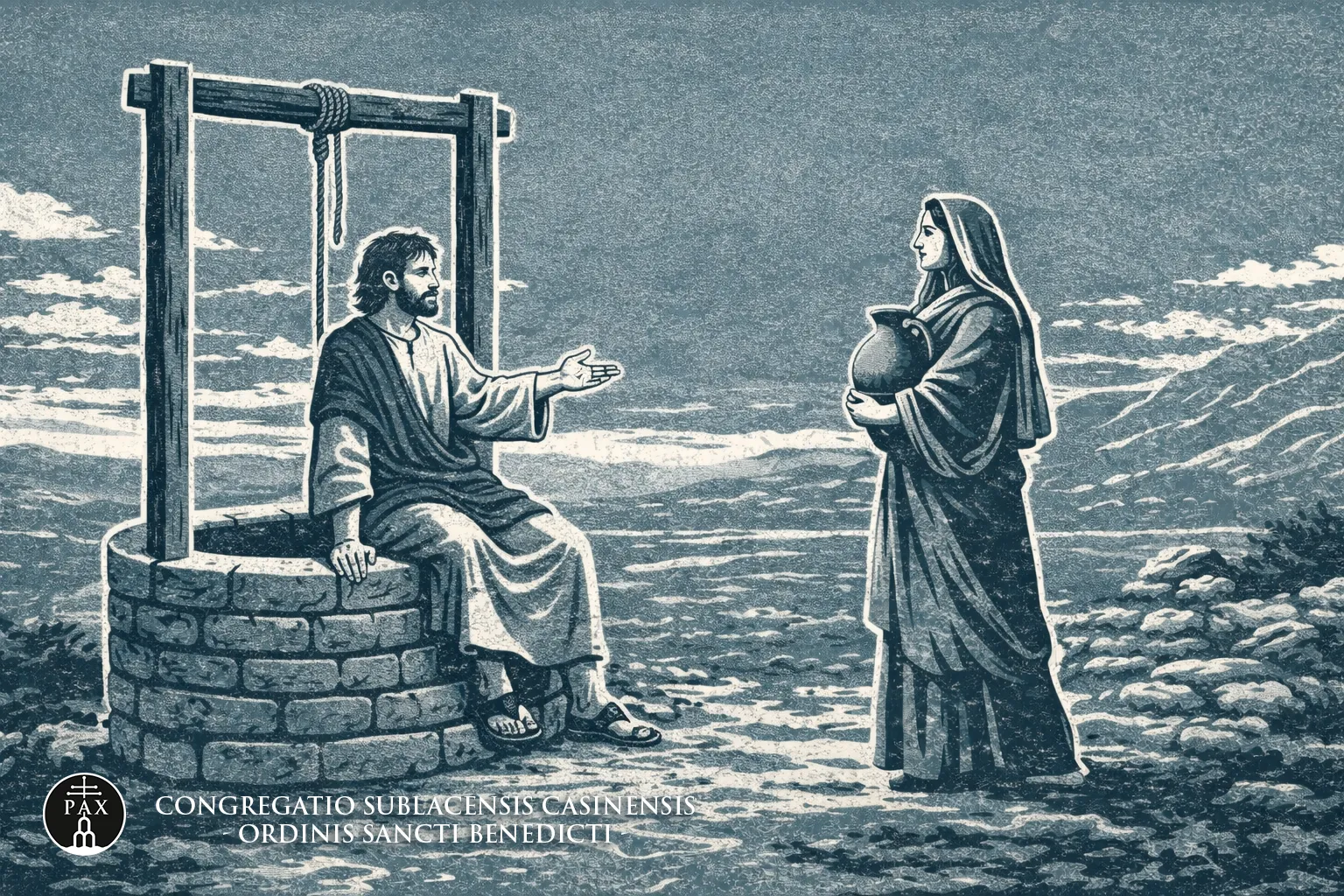
“If you knew the gift of God…” (John 4:10). You believe that God’s gift is the well, with the water of the Fathers that you draw from it. Of course, water is also a gift of God, but there is another water, another well from which you have not yet drawn, a water you have not drunk to quench your thirst, a gift you have not yet received. “If you knew who it is that says to you, ‘Give me a drink…'” (John 4:10). If you had even a vague perception of that man who is speaking to you, of his secret, of his thirst (which is also a thirst for you). If you knew… but you do not know, you suspect nothing. You don’t know this stranger, this mysterious traveler who asks for water but also wants to give it. But you don’t know, you don’t even know who you are. In fact, you have no name, yet you certainly know your life, you know the many men you’ve had, perhaps love. You know Jacob’s water, perhaps even his God. But do you know yourself? Do you really know who you are? Who you could be? You don’t know that from this encounter you will emerge different, you will become someone else. Yes, you will leave your pitcher unattended to run into the city and call the people. You will be the first Christian missionary. Even before the martyr Stephen, before Peter, the rock, long before Paul. And while the Twelve go looking for bread, you—after he has spoken to you—run to announce the good news. If Jesus is the one sent by the Father, you will be the woman, and a Samaritan at that (and therefore a heretic for the Jews), to be the first missionary in history. “If you knew…” We are all like you, dear Samaritan sister, we are all without knowledge. We do not know God or his Son. We are illiterate. Oh, sure, our libraries are overflowing with theological knowledge about God and Christ. But it is a knowledge that only touches the head and rarely the heart; a theoretical, not existential, knowledge. But Jesus also came for us, and day after day he teaches us to spell God’s name. With infinite patience he helps us understand that the Father is beyond our sanctuaries, that he is the Father of every man, of those who seek him but also of those who reject him by ignoring him. He gives us the living water of the Spirit, because it opens us to broader horizons. And here the miracle happens. Like the Samaritan woman, we become a source of living water that wells up to eternal life.
You came to quench your thirst with the water of Jacob, your father.
But now you thirst for the water of God,
your true Father.
Your thirst has grown greater
because God has become greater:
you thirst, yes, for a non-tribal God,
you have a great thirst for a great God.
Commentary by b. Sandro Carotta, osb
Abbazia di Praglia (Italy)
Translation by f. Mark Hargreaves,
Prinknash Abbey