

November 1, 2026
All the Saints
Holiness is making room for God: in the Beatitudes, Jesus reveals a new life, where the Kingdom transforms suffering, time, and the heart.
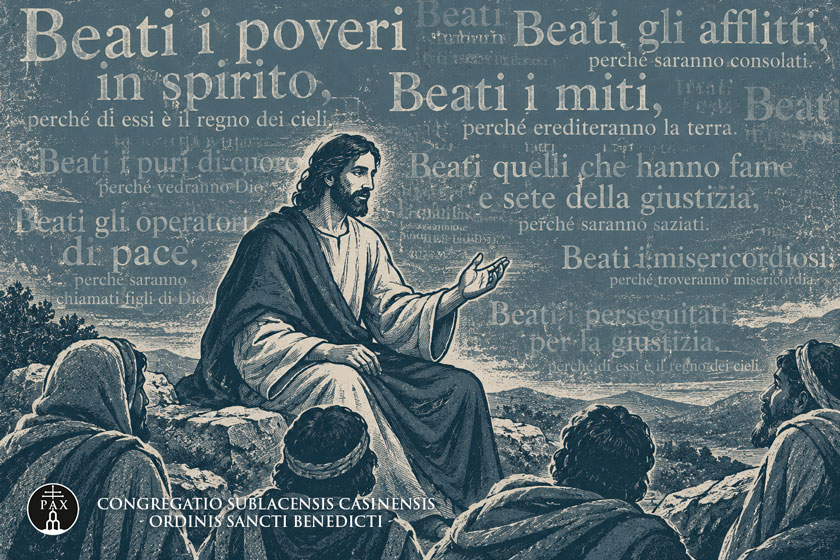
HOLINESS: MAKING ROOM FOR GOD
Today we celebrate the Solemnity of All Saints. But what do we mean by holiness? Holiness—kedushà—is one of the most frequently used terms in Leviticus, where the root k-d-sh appears as many as 150 times. What does it mean? First and foremost, it means “to set apart,” “to dedicate,” “to designate for a purpose.” To understand this first meaning, we must turn to Jewish marriage. Marriage is called kiddushin and refers to when a woman is “dedicated” to a man within a unique relationship. When God sanctifies the people, the term takes on the same meaning it has in marriage—that is, the people become God’s possession, His segullah (holiness as belonging). Rav Joseph Soloveitchik, on the other hand, wrote that holiness consists in being at home in space and time. Every child of Israel is at home in sacred space (kedushat makon)—that is, finds God everywhere—and is at home in sacred time (kedushat zeman), in that they find God in the past, present, and future (which they can barely glimpse) (holiness as an experience of God within the coordinates of space and time). For Rabbi Abraham Isaac Kook, on the other hand, holiness is that dimension where everything converges and everything finds synthesis and unity within divine unity and its infinite light. The profane is division and conflict; holiness is harmony and balance (holiness as unity that gives light and life to everything). But that is not all. In the Scriptures, holiness has been linked to Shabbat, the Sabbath, and the Mikdash, the Tabernacle. The Sabbath marks a pause in the work of creation, a void of activity. As for the Tabernacle, its primary function was to demarcate a space within which lay the Holy of Holies , containing the Ark, which held only a few items (the Tablets of the Law, Aaron’s staff, and the manna). Everything else was empty. We can therefore say that holiness is emptiness: empty time (the Sabbath), empty space (the Tabernacle). This emptiness is God’s tzimtzum —that is, His voluntary self-limitation—so that humanity may stand before Him free to determine its own destiny. What, then, is God’s holiness if not a crack in the universe’s self-sufficiency through which He enters time and space? He bursts into time through the Shabbat and into space through the Mikdash. And what is human holiness if not that which a person leaves free within himself for God? This applies to a Christian as well, of course. But then, what does the passage on the Beatitudes have to tell us? That, thanks to Jesus, we have entered a world marked by new values that dwarf the previous ones—such as well-being for one’s own sake, unjust wealth, and success at the expense of others. Not only that, but the Beatitudes do not eliminate suffering and death; rather, they teach a new way to face them and show that the promised blessedness can already be foreshadowed as we await the fullness of the Kingdom.
Commentary by d. Sandro Carotta, osb
Abbazia di Praglia (Italia)