

February 22, 2026
I Sunday of Lent
Year A
In the desert, Jesus discovers true humanity: not possessing, not using God, not seeking power. Thus, his humanity becomes a reflection of God’s face.
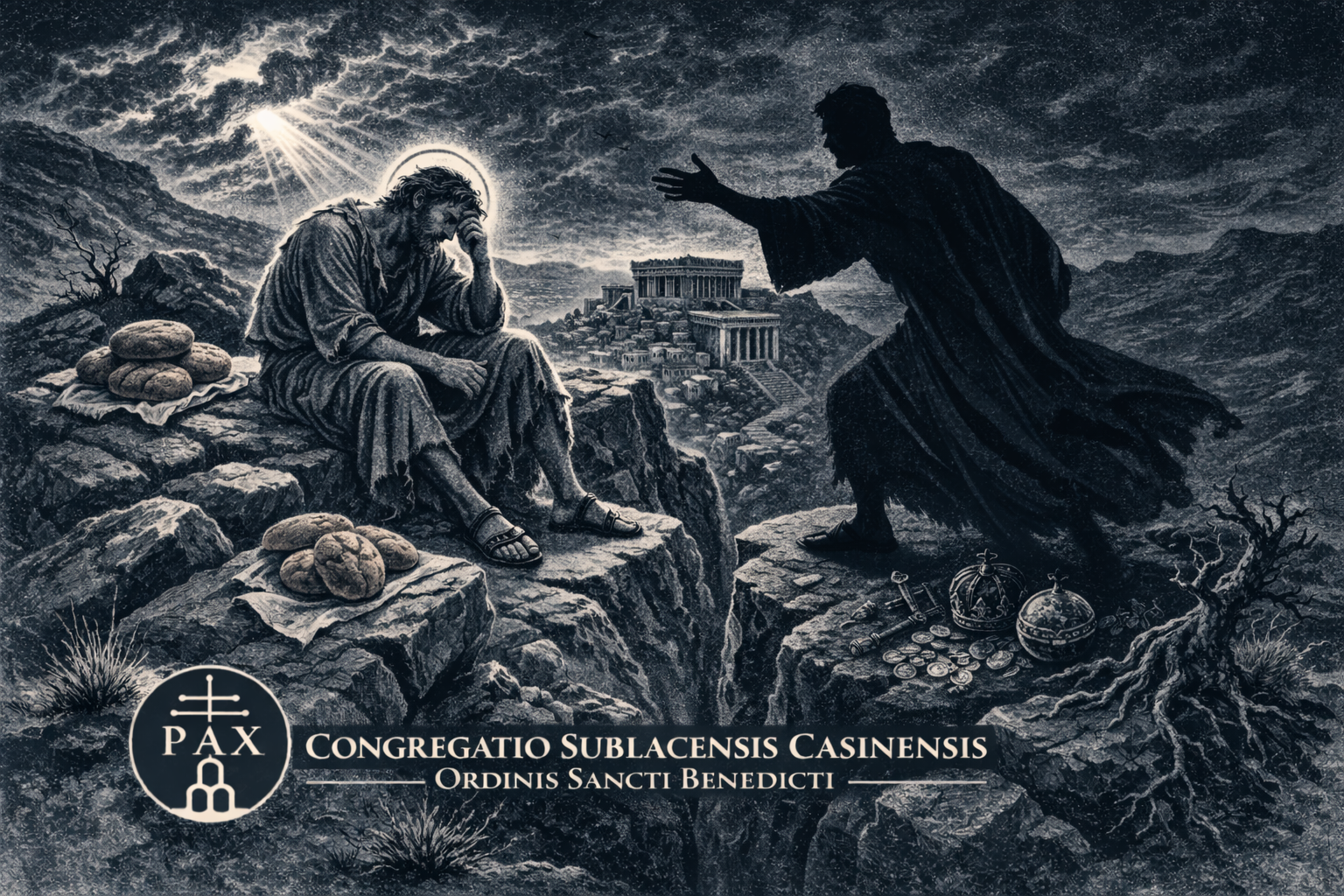
BECOMING MAN, ACCORDING TO GOD
On this First Sunday of Lent, we are faced with an important Christological icon. But before observing some of its features, we want to ask ourselves: who was that young Jewish man, born in a remote village in the North, welcomed by some as a savior while by others put to death as an impostor? He was born around 3760, according to the calendar of his people, and according to precise instructions from above, given, however, only to his mother (cf. Luke 1:31). He was named Yeshùa, which means “God saves.” Today, however, he is known by a name not entirely faithful to its original Hebrew: Jesus. Circumcised, like all males in Israel, he was then admitted, around the age of thirteen, through the rite of bar mishpat, to the public reading of the Scriptures. After that, a long and mysterious silence was confirmed by the evangelists. Only Luke, soberly, attests to us that he “increased in wisdom and age, and in favor with God and man” (Luke 2:52). But then nothing else. When, as an adult, he returned to his home in Nazareth, everyone was amazed at his words and said to one another: “Is not this Joseph’s son?” (Luke 4:23). Yes, he was a carpenter, like his father, and he had been raised among the smells of resin, glue, and grease until the day he lined up at the Jordan to receive a baptism of repentance from his cousin, John the Baptist. From that event, however, things changed. He immediately withdrew to the desert for forty days. There he internalized what he had heard at the river from a mysterious voice that had resonated in the heavens of his soul, and only later did he begin to proclaim the Gospel of God to an exhausted and expectant humanity. But what did this retreat into this solitary hermitage entail? Simple: there, where only silence witnessed his travail, he understood what it means to be human. He understood that one must not use everything for oneself or consume everything for one’s own benefit. In short, to be human, it is illusory to turn everything into an edible dish, and that it is dehumanizing to always and only measure one’s own usefulness. Man is such when he knows how to nourish himself with God, without whom there is no bread that satisfies, but only disgust and nausea. And that bread, to never run out, must be shared. Nor did he seek to appropriate God, that is, to use him to increase his own self-esteem or success. He did not abuse the sacred, seeking miracles; he never tempted God, whom he boldly called Father. It is clear, then, that he rejected every form of power. It was the third temptation, perhaps not the main one, but certainly the most dangerous. He emerged victorious, so much so that his humanity became a reflection of God’s very face. Yeshua‘s human traits are important to us, not only to understand who he was but also to be able to confess the divine side of his person. It is not enough, then, to believe that Jesus is the Messiah, the Son, but to recognize that God manifested himself in his beautiful humanity, which blossomed in the blessed solitude of the desert.
Let us listen to a poetic commentary by Mother Anna Maria Cànopi:
Man,
divine chrysalis
in the cocoon of your mystery
you always wait
to be born
again.
Commentary by b. Sandro Carotta, osb
Abbazia di Praglia (Italy)
Translation by f. Mark Hargreaves,
Prinknash Abbey